
Flood Damage Cleanup and Water Extraction in Bozeman, MT
Water on the floor right now, from snowmelt, a river or a sump pump that quit? Flood damage cleanup starts with water extraction and drying inside the first 48 hours, before mold gets a start. Tell us what happened and get a free quote from an independent Gallatin Valley water damage company.
Get a Free Quote Call (406) 476-0213Flood damage cleanup: the first 48 hours
The EPA and the CDC both put the drying deadline at 24 to 48 hours. This is how that window usually gets spent.
Hour one: make it safe
Shut off power to the flooded rooms at the breaker, but only if you can reach the panel without standing in water. Assume river water, groundwater and anything that crossed a field or a septic system is contaminated. Boots, gloves and an N95 before you wade in.
Hours one to six: record it, then call
Video every room, the waterline on the walls and each damaged item before anything moves. Write down when you found it. Then get a water damage company on the phone. Do not hold off on drying until an adjuster has seen the room.
Day one: water removal
Standing water is pumped out and the rest is pulled from carpet, pad and floor seams with extraction vacuums. Soaked pad and area rugs normally leave the house at this point.
Day one to two: open it up
Baseboards come off, cabinet toe-kicks are opened and flooded drywall is cut out above the waterline so the framing can dry. Wet insulation behind it goes too.
By hour 48: equipment running
Air movers and dehumidifiers are set and the first round of meter readings is on paper. From here the job is monitoring, not emergency work.
The rule behind the timeline. “It is important to dry water-damaged areas and items within 24-48 hours to prevent mold growth” (EPA, A Brief Guide to Mold, Moisture and Your Home). Everything above is about beating that clock.
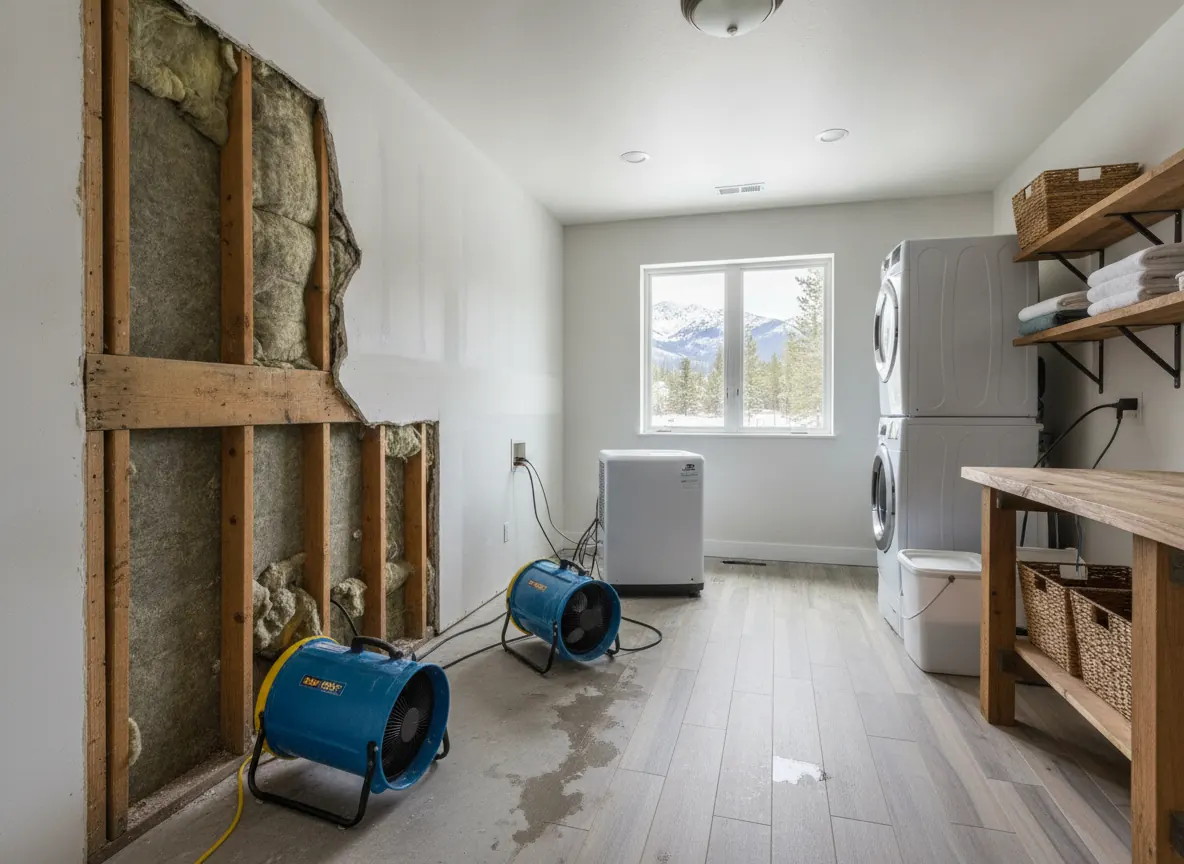
What water extraction services include
Water extraction services and water removal services are two names for the same first step: getting liquid water out of the building so drying can begin. A quote for it should spell out four things.
- Pumping and extraction. How standing water leaves the house, and whether carpet is extracted in place or lifted.
- What comes out. Pad, rugs, soaked boxes and furniture that cannot be saved, with photos and a list for your claim.
- Drying equipment. How many air movers and dehumidifiers, in which rooms, and who checks them.
- Readings. Moisture numbers for walls, subfloor and framing, written down each visit until they hit the dry target.
The source of the water decides how much can be kept. Restoration companies sort it into clean, gray and black water. A supply line that split is clean. River water, snowmelt that ran across a yard and any sewer backup count as black, and porous materials that soaked it up are removed, not dried.
Four kinds of flooding in the Gallatin Valley
Flood damage restoration is not one job. What a water damage company in Bozeman finds when it arrives depends on where the water came from.
Rivers out of their banks
The Yellowstone at Livingston, the Gallatin from Gallatin Gateway down to Manhattan, the East Gallatin through Bozeman and Belgrade, and the Jefferson and Madison at Three Forks, where about 80 percent of structures sit in the regulatory floodplain. River floods leave silt, a clear waterline and contaminated walls. Expect drywall and insulation to be removed to above that line. Livingston saw this in June 2022, when 205 Park County residences were damaged.
Snowmelt across frozen ground
Bozeman gets 86 to 91 inches of snow a year. When it goes in March and April the soil is still frozen just below the surface, so meltwater runs to the foundation, fills window wells and comes in at the slab edge. This is the common one: an inch of water across a finished basement, not a river in the living room. April 2018 brought flood warnings to the whole valley this way.
Groundwater from below
Around Four Corners the shallow aquifer sits roughly 55 feet down and rises with runoff. Water that arrives from underneath keeps coming until the water table drops, so extraction alone does not end it. Crawl spaces take it first; see crawl space mold removal if yours stayed damp into summer.
Sump pump failure
A pump that loses power or burns out in the middle of runoff gives you groundwater flooding with no warning. Ask the company to note the cause in writing, because insurers treat a failed pump differently from a river.
Flood restoration or water damage restoration?
Companies use these labels loosely, so here is the working difference. Flood restoration deals with water that came from outside: rivers, runoff, groundwater. It is dirtier, it usually means more demolition, and a standard homeowners policy does not pay for it. Water damage restoration is the broader term and most often describes inside sources such as a frozen pipe or a failed water heater, where the water is clean and more of the room can be dried in place.
If your loss came from plumbing, or you want the drying, monitoring and rebuild steps laid out in order, read the water damage restoration in Bozeman page. This page stays with flood events and the extraction that follows them.
When mold follows a flood
Miss the 48-hour window and the job changes. MSU Extension tells Montana homeowners to throw out porous items that stayed wet more than two days, and to bring in a professional once mold covers more than about 15 square feet. After a flood both thresholds are easy to cross, because the wet area is measured in rooms.
The signs tend to show up weeks later: a musty smell that returns when the furnace runs, dark speckling low on a wall that was only wiped down, flooring that cups. If that is where you are, the work is no longer flood cleanup. It is mold remediation under containment, and a mold inspection with moisture readings is the way to find out how far it goes. Finished lower levels are the usual place; see basement mold removal.
What flood damage cleanup costs
Published national estimates and typical Bozeman-area ranges. None of these is a quote.
| Item | Range | Source |
|---|---|---|
| Water extraction, per sq ft | $3.75 – $7.50 | Fixr, Jan 2025 |
| Black water (river, sewage), per sq ft | $7 – $7.50 | Fixr, Jan 2025 |
| Whole restoration job, national | $1,200 – $5,000 | Fixr, Jan 2025 |
| Mold remediation for a flooded room, Bozeman area | $2,000 – $6,000 | Site cost guide |
Flood jobs lean toward the top of the extraction range because the water is contaminated. Rebuild and contents are priced on their own lines. The mold remediation cost guide covers the mold side in full.
Flood insurance, FEMA and your paperwork
Standard homeowners insurance does not cover river or surface-water flooding; that takes a separate flood policy. After a federal disaster declaration, such as DR-4655 for the June 2022 Yellowstone flood, FEMA individual assistance may help with uninsured essential repairs, but it is not built to pay for a full restoration. Whichever applies, the file is the same: dated photos and video, the written scope, the moisture log and the list of what was thrown out. Nobody quoting your job can tell you what your policy covers. Call your agent early.
Questions for any water damage company
- How soon can extraction start, and who is on site each day after that?
- Do you follow the IICRC S500 standard for drying, and will I get the daily moisture readings?
- Is river or sewer water handled differently in your scope than clean water?
- Do you do the mold portion and the rebuild yourselves, or hand them off?
- Will the written scope separate extraction, drying, demolition and repairs?
Montana has no state license for mold remediation, so the written scope is your main protection once a flood job turns into a mold job.
Flood cleanup and water extraction questions
How soon does water extraction need to start after a flood?
As soon as the house is safe to enter. The EPA and CDC both say to dry water-damaged areas within 24 to 48 hours to prevent mold growth, and drying cannot begin until standing water is out. Photograph everything first, then start. Waiting several days for an adjuster is how a flood job turns into a mold job.
Can I do the water removal myself?
For a small amount of clean water on a hard floor, a wet vacuum, fans and a dehumidifier may be enough. Floodwater from a river, snowmelt runoff or a sewer backup should be treated as contaminated, and water that got under flooring or into walls needs meters to confirm it is dry. If more than a room is involved, get a quote.
Is river floodwater handled differently from a burst pipe?
Yes. Restoration companies class river and sewage water as black water. Carpet, pad, drywall and insulation that absorbed it are removed, not dried in place, and the published extraction rate is higher: $7 to $7.50 per square foot against $3.75 to $4.25 for clean water (Fixr, Jan 2025).
Does homeowners insurance pay for flood damage restoration in Montana?
Usually not. Standard homeowners policies exclude river and surface-water flooding, which needs separate flood coverage. Sudden plumbing failures are a different category and are often covered. In a declared disaster FEMA individual assistance may help with essential repairs. Ask your agent, and keep photos, receipts and the written scope.
Can I get a flood cleanup quote outside Bozeman?
Yes. Quote requests come from Livingston and Park County, Three Forks, Belgrade, Manhattan, Four Corners and the rest of the Gallatin Valley. Say which town you are in and where the water came from so the reply comes from a company that works there.
Back to the main page for mold remediation in Bozeman, MT, or see all service areas.
Worried about mold? Get a straight answer and a free quote.
Tell us what you're seeing. We reply fast, usually the same day, with a clear plan and typical pricing.