
Basement Mold Removal
Finished and unfinished basements wet from snowmelt and groundwater.
Learn more →Burst pipes in January, snowmelt in April, river floods in June. Water damage restoration is the extraction and drying job that follows, and mold cleanup is what it turns into when materials stay wet too long. Tell us what happened and get a free quote from an independent local company that does this work in the Gallatin Valley.
Get a Free QuoteThese are the typical steps restoration companies describe. The IICRC S500 standard for professional water damage restoration is the industry reference most of them cite; ask the company you choose whether it follows it.
The leak is shut off or the flood recedes, the water is classified as clean, gray or black (sewage and river water count as black), and standing water is pumped and vacuumed out. Saturated carpet and pad usually come up at this stage.
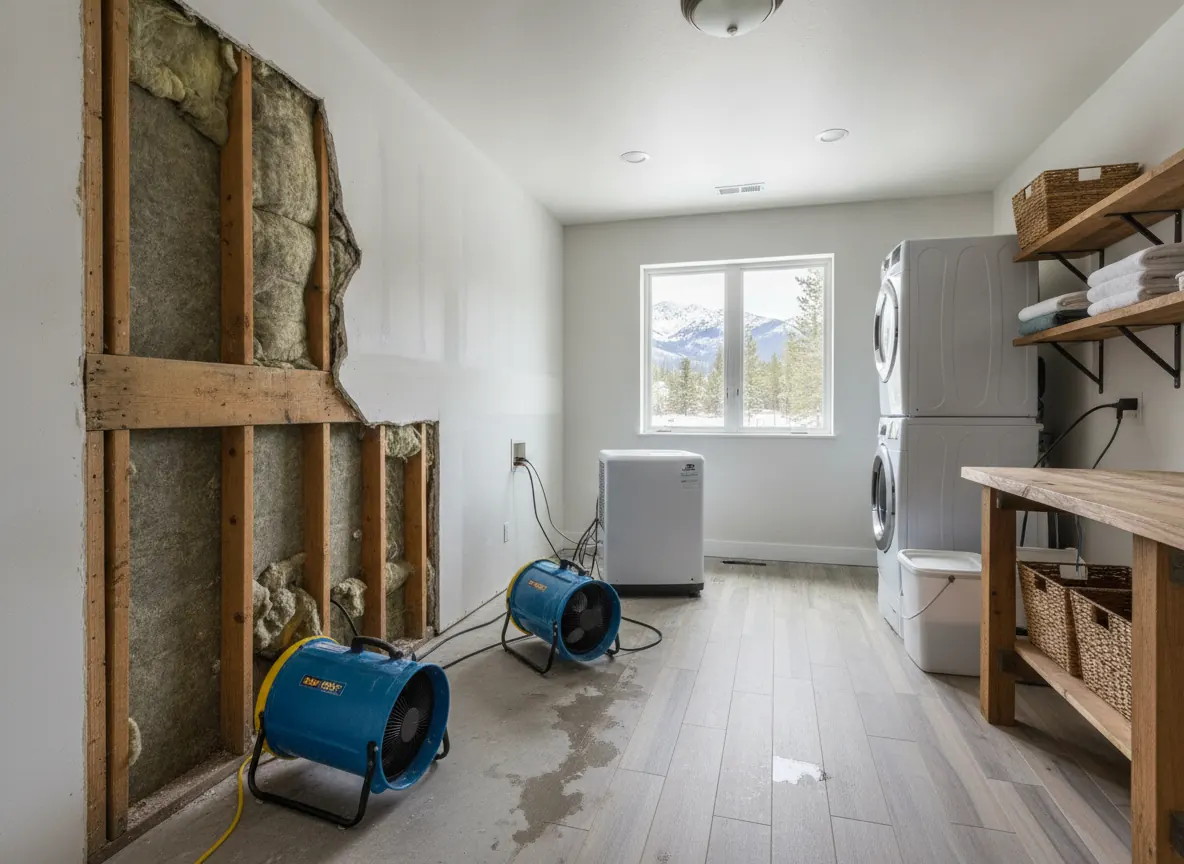
Air movers push air across wet surfaces and dehumidifiers pull the moisture out of the room. Cabinets, baseboards and sometimes drywall are opened so air reaches the framing behind them.
Meter readings are taken daily and logged until materials reach their dry target. This log is what shows an adjuster the structure was actually dried rather than just left to air out.
Surfaces that stayed wet are cleaned and treated with an antimicrobial. Porous materials that were wet for more than about two days, or anything already showing growth, move into mold remediation under containment.
Drywall, insulation, flooring, trim and paint go back in once readings are at target. Many restoration companies do this themselves; others hand off to a separate contractor, so ask which applies to your quote.
Water remediation, also called water mitigation, is the emergency half of the job: stopping the source, extracting water and drying the structure so damage stops getting worse. Water damage restoration usually means that same drying work plus the repairs that bring the home back, and some companies use the two terms interchangeably. Either way, the goal is to get materials dry fast enough that mold never gets started.
Mold remediation is what happens when drying was too late or never done. It is a separate scope with its own steps: containment, negative air with HEPA filtration, removal of porous materials that cannot be cleaned, surface cleaning and verification, following the IICRC S520 standard rather than S500. Some local companies do both; others do one and refer the other. If your loss is fresh, you need water remediation first. If the home already smells musty or you can see growth, you need mold remediation, and the mold remediation process page explains that work step by step.
Published national estimates, not quotes. Rebuild, contents and the mold remediation portion are usually priced separately.
| Item | Published range | Source |
|---|---|---|
| Water damage restoration, typical job | $1,200 – $5,000 (average about $3,000) | Fixr, Jan 2025 |
| Water damage restoration, typical job | $1,364 – $6,301 (average about $3,833; $450 to $16,000 overall) | HomeAdvisor, 2025 |
| Water extraction, per sq ft | $3.75 – $7.50 | Fixr, Jan 2025 |
| Clean water (Category 1), per sq ft | $3.75 – $4.25 | Fixr, Jan 2025 |
| Gray water (Category 2), per sq ft | $4.10 – $6.50 | Fixr, Jan 2025 |
| Black water (Category 3), per sq ft | $7 – $7.50 | Fixr, Jan 2025 |
| Mold remediation portion, per sq ft | $4.75 – $5.50 | Fixr, Jan 2025 |
Bozeman-area quotes can sit above these national figures because of travel distance to Big Sky, West Yellowstone and Ennis and the winter timing of most burst-pipe losses. The only number that matters is a written scope for your home: request a free quote and compare it line by line.
Fast. The EPA says water-damaged areas and items should be dried within 24 to 48 hours to prevent mold growth, and that if materials are dried in that window, in most cases mold will not grow (EPA, Brief Guide to Mold, Moisture and Your Home). The CDC gives the same 24 to 48 hour window for cleaning and drying a home after a flood (CDC, 2024). Anything still wet after two days should be treated as a possible mold problem, not just a drying problem.
Water remediation or mitigation is the emergency drying work: stop the source, extract, dry, monitor. Restoration usually adds the rebuild, from drywall and insulation to flooring and paint. Companies use the terms loosely, so read the scope rather than the label and ask whether rebuild is included in the price.
Published national estimates put a typical job between $1,200 and $5,000 with an average near $3,000 (Fixr, Jan 2025), or between $1,364 and $6,301 with an average near $3,833 (HomeAdvisor, 2025). Extraction runs roughly $3.75 to $7.50 per square foot depending on whether the water was clean, gray or black (Fixr, Jan 2025). These are not quotes; a written scope for your home is the only real number.
If the loss happened in the last day or two and nothing smells musty, you need water damage restoration first, and fast drying may mean no mold work at all. If the water sat for days, the house smells musty or you can see growth, you need mold remediation, often alongside the drying. Many Gallatin Valley companies do both; tell us what happened and the company that replies can scope the right work.
A pipe freezes and splits during a January cold snap, and a bathroom ceiling comes down. A water heater lets go in the basement over a long weekend. A river comes up in June. The water itself is the first problem; the mold that follows inside wet walls, under flooring and behind cabinets is the second, and it starts within a day or two.
The mistake most people make is stopping once the surface looks dry. Drywall, carpet pad and framing hold water long after the floor feels fine, and a fan pointed at a wall does not dry what is inside it. Water damage restoration done right is a drying job measured with meters, followed by mold remediation wherever the materials stayed wet too long.
Cold does the damage here. With January lows averaging 12°F in Bozeman and 0°F in West Yellowstone, pipes in exterior walls, crawl spaces, garages and unheated second homes freeze and burst every winter. Big Sky, where 57 percent of housing units sit vacant as second homes, sees burst pipes discovered weeks after the fact, which is long past the 24 to 48 hour window.
Then there is flooding. Spring snowmelt brought valley-wide flood warnings in April 2018, and the Gallatin River hit roughly 8,930 cfs in June 2022. The same June, the Yellowstone River flood damaged 205 residences in Park County, destroyed three and partially damaged 76, with southeast Livingston and the Ninth Street Island area hit hardest under FEMA disaster declaration DR-4655. In Three Forks, about 80 percent of structures sit in the regulatory floodplain. Floodwater soaks everything below the waterline, carries silt and contaminants, and leaves walls wet for far longer than two days unless they are opened up and dried on purpose.
Dry it on purpose, remove what stayed wet, document everything. This is what to expect from the company you choose.
Once the water source is off, the crew extracts standing water, pulls wet carpet and pad, and sets air movers and dehumidifiers. The sooner this starts, the less mold remediation you will need.
Moisture meters and thermal imaging map how far the water traveled inside walls, under floors and into adjacent rooms. Photos, readings and a written scope go to you and, if you want, your insurance adjuster.
Porous materials wet more than two days are bagged and removed under containment with HEPA air filtration. Framing and hard surfaces are cleaned, treated and dried to target readings. Ask any company you talk to which standards, such as IICRC S520, it follows for the mold portion.
Moisture readings are logged until materials are at target, third-party clearance testing is offered as an option, and a clean, dry structure is handed off to the rebuild contractor along with the documentation your insurer needs.
| Job | Typical range |
|---|---|
| Water-damage + mold (burst pipe/flood room) | $2,000 – $6,000 |
| Basement (one area) | $1,000 – $4,000 |
| Whole-home / major | $10,000 – $30,000+ |
| Post-remediation clearance test | $200 – $400 |
Contents removal adds roughly $300 to $1,000 depending on volume. Rebuild and drywall are quoted separately. See the full price table and calculator on our mold remediation cost guide, or request a free quote for a written scope on your home.
Adjusters want to see cause, timeline and evidence. Photograph the source and the damage before anything is moved, note the date and time you discovered it, and keep every receipt. Ask the company you hire for the written scope, the moisture log, the disposal inventory and before-and-after photos; good companies produce those on every water loss because they answer the questions an adjuster will ask.
Sudden events like burst pipes are treated differently from slow leaks and seasonal seepage, and mold coverage often has its own limit. No contractor can interpret your policy for you, but complete paperwork makes the claim far easier. For flood losses, FEMA assistance and flood insurance follow their own rules; keep your claim numbers with your documentation.
MSU Extension’s guidance is to discard porous items that stayed wet for more than two days: carpet and pad, upholstered furniture, mattresses, paper-faced drywall, fiberglass insulation and particleboard. Hard, non-porous materials like framing, concrete, metal and solid wood can usually be cleaned and dried. Ask the company to photograph and inventory everything removed so your insurer sees the reason for each item.
Often the sudden water event, like a frozen pipe that bursts, is covered, and mold that results from it may be covered up to a limit, while mold from long-term leaks or neglected maintenance usually is not. Policies vary a lot. Call your carrier early, document everything with photos and dates, and ask the company for the written scope, moisture logs and disposal inventory they will want.
Most burst-pipe or flooded-room jobs in the Bozeman area fall between $2,000 and $6,000 for the mold remediation portion. Larger losses, like a finished basement under a foot of water, can move into the whole-home range of $10,000 to $30,000 or more. Rebuild is separate. The cost guide explains how the square-foot math works.
Yes. Quotes are available for Livingston and the surrounding Park County area, which saw 205 residences damaged in the June 2022 Yellowstone River flood, with southeast Livingston hit hardest. Flood-soaked homes that were not fully dried in time still show mold years later behind finished walls. If your home was affected and still smells musty, an inspection with moisture readings is the place to start.
Finished and unfinished basements wet from snowmelt and groundwater.
Learn more →What dark mold on soaked drywall means and how it is removed.
Learn more →Typical Bozeman-area price ranges, a square-foot calculator and the factors that move a quote up or down.
Learn more →This service is available across Bozeman & the Gallatin Valley, MT, including:
See all service areas or learn how the process works.
Tell us what you're seeing. We reply fast, usually the same day, with a clear plan and typical pricing.